Showing posts with label Business. Show all posts

Monday, May 2, 2011

India asks Reliance to boost gas output with more wells


Gas production from a key block off the east coast operated by Reliance Industries has fallen further, the upstream regulator said on Monday, adding the company has been asked to drill 11 new wells by April 1, 2012, to boost output.

Reliance is pumping less gas than it should from the D6 block of Krishna-Godavari basin, the second biggest gas producer in India after Mumbai High. It was supposed to drill nine wells in this fiscal year.

Upstream Regulator SK Srivastava said Reliance has now been asked to drill two extra wells that it failed to drill in 2010/11.

Srivastva said Reliance was currently producing 48 Mmscmd gas from the D6 block, adding it would meet Reliance officials later this month to discuss the fall in gas output.

"In a week or two we will be meeting again and the operator has been asked to come up with the proposal to drill wells as per the plan," Srivastava told reporters after a meeting with Reliance executives.

On April 21, Srivastava said Reliance was producing 50 Mmscmd from the block.

"From the government's perspective gas production was the main issue. We deliberated with the operator about drilling more wells and bringing up the production," he said.

Reliance offered no comments, saying they were not aware of the details of Monday's meeting with the regulator.

The company, which has agreed a broad parternship with multinational BP on field development in a deal worth USD 7.2 billion, said in March it wanted to work to overcome "the technical challenge involved in these complex reservoirs."

Srivastava said last month Reliance had not given a satisfactory reason for the shortfall. Reliance has drilled 20 of the 22 wells it was supposed to in FY11.

The concerns over Reliance's gas production have for months dampened growth outlook for the Indian energy giant and kept its shares under pressure.

India may have to step up imports of costlier Liquefied Natural Gas (LNG) to meet the shortfall.

Meanwhile, Srivastava said to CNBC-TV18, "We have deliberated at length with the operator about drilling the wells and bringing up the production. in this meeting opeartor has said that he'll be coming up with the proposal for drilling the well shortly and we will be having another meeting in maybe a week or 2 weeks't ime with the operator."

Osama’s wife was human shield against raiders


One of Osama bin Laden’s wives stood between him and U.S. Navy SEALs as the world’s most-wanted terrorist was gunned down in an airborne assault on the al-Qaeda leader’s safe house deep in Pakistan. He was holed up less than a mile (1.6 kilometres) from the country’s military academy and not far from the capital of Islamabad.

Details emerged Monday of the life and dramatic death of bin Laden, the day after President Barack Obama made the stunning near-midnight announcement that the al-Qaeda leader had been killed.

Mr. Obama, while assured bin Laden probably was in the compound, did not know with certainty that the 10-year hunt for the notorious son of a Saudi Arabian construction magnate was at an end until his body was carried to one of four U.S. Special Operations helicopters that had ferried in the American force deep inside Pakistan. One of the craft was damaged on landing and blown up before the return journey to Afghanistan.

On Monday the President said the terrorist mastermind’s death was “a good day for America.”

The administration said DNA testing administered on the body before it was buried at sea from the deck of the USS Carl in the North Arabian Sea confirmed the man killed was indeed bin Laden.

Photo analysis by the CIA, confirmation by a woman believed to be one of bin Laden’s wives on site, and matching physical features like bin Laden’s height all helped confirmed the identification. White House officials were deciding the merits and appropriateness of releasing a photo of bin Laden’s body. He was shot above his left eye, blowing away part of his skull.

“The world is safer. It is a better place because of the death of Osama bin Laden,” Mr. Obama said, although security officials in the U.S. and around the globe warned against retaliatory al-Qaeda attacks.

Mr. Obama hailed the pride of those who broke joined overnight celebrations as the stunning news spread around the globe. Crowds celebrated throughout the night outside the White House and at ground zero in Lower Manhattan where the Twin Towers once stood. Mr. Obama was planning to visit there on Thursday and meet with the families of those killed nearly 10 years ago, an administration official said.

Both Mr. Obama and Secretary of State Hillary Rodham Clinton said cooperation from the Pakistani government had helped lead U.S. forces to the compound where he died. But a cloud of suspicion hangs over Pakistan, where authorities have routinely denied bin Laden was in the country. U.S. officials, however, said the sprawling bin Laden compound, with its elaborate security and 18-foot (5.5-meter) walls, was built in 2005, apparently to served as the terrorist leader’s safe house.

Unanswered is the obvious question of how bin Laden could have gone unnoticed just down the road from the country’s equivalent of the U.S. military academy at West Point, New York, in a town swarming with military and intelligence personnel.

“People have been referring to this as hiding in plain sight,” Mr. Obama’s counterterrorism chief John Brennan told reporters Monday. “Clearly, this was something that was considered as a possibility. Pakistan is a large country. We are looking right now at how he was able to hold out there for so long and whether or not there was any type of support system within Pakistan that allowed him to stay there.”

Others were more blunt.

Sen. Carl Levin, Democratic chairman of the Senate Armed Services Committee, said the Pakistani Army and intelligence agency “have a lot of questions to answer, given the location, the length of time and the apparent fact that this was actually -- this facility was actually built for bin Laden, and its closeness to the central location of the Pakistani army.”

In addition to bin Laden, one of his sons, Khalid, was killed in the raid, Brennan said. Bin Laden’s wife was shot in the calf but survived, a U.S. official said. Also killed were two of bin Laden’s al-Qaeda facilitators, including the one who was apparently listed as the owner of the residence, Brennan said.

Mr. Obama gave preliminary orders for the attack on Friday shortly before flying to Alabama to inspect tornado damage, and aides set to work on the details. He gave the final directive Sunday. Brennan called it one of the “gutsiest calls of any president in recent memory.”

MR. Brennan said the president and his national security team monitored the raid from the White House Situation Room and expressed relief that elite forces had finally gotten bin Laden without losing any more American lives.

“It was probably one of the most anxiety-filled periods of time in the lives of the people who were assembled here,” Brennan said. “The minutes passed like days.”

Brennan strongly suggested a live video feed had been available -- SEALs customarily have video cameras attached to their helmets -- and the White House released a photo showing the commander in chief, Vice President Joe Biden and top aides staring intently at something outside the picture. The White House did not say what they were looking at.

Mr. Obama on Monday reaped accolades from world leaders he’d kept in the dark about the operation as well as plaudits from political opponents at home. Republican and Democratic congressional leaders alike gave him a standing ovation at an evening meeting that was planned before the assault but became a celebration of its success.

The dramatic developments came just months ahead of the 10-year anniversary of the hijacked-airliner assaults on the United States. Those attacks took nearly 3,000 lives, led the U.S. into war in Afghanistan and Iraq and forever pierced the notion that the most powerful country on earth could not be hit on such a ferocious scale.

Officials say CIA interrogators in secret overseas prisons in Eastern Europe developed the first strands of information that ultimately led to the killing of bin Laden. Intelligence officials have long known that bin Laden trusted one al-Qaeda courier in particular, and they believed he might be living with him in hiding. Four years ago, the United States learned the man’s identity, which officials did not disclose, and then about two years later, they identified areas of Pakistan where he operated. Last August, the man’s residence was found, officials said.

By mid-February, intelligence from multiple sources was clear enough that Mr. Obama wanted to pursue action, a senior administration official said. Over the next two and a half months, the president led five meetings of the National Security Council focused solely on whether bin Laden was in that compound and, if so, how to get him, the official said.

Once under way, four helicopters ferried the U.S. forces to the Abbottabad compound, lowered the SEALS behind the walls and began descending toward a landing. No shots were fired, but shortly after the team hit the ground, one of the helicopters came crashing down and rolled onto its side for reasons the government has yet to explain. None of the SEALs was injured, however, and the mission continued uninterrupted. The crippled aircraft was destroyed before the raiding party flew out in the three remaining helicopters.

U.S. officials have not explained how they managed to secretly fly four helicopters across the Pakistan border to near the capital and into a military garrison city that was home to the country’s military academy. What’s more, it remained unclear how the SEAL team was able to conduct what was described as a 40-minute mission, including a fire fight and the explosives destruction of a helicopter, without the Pakistan military or police intervening.

Bin Laden’s death came 15 years after he declared war on the United States. Al-Qaeda was also blamed for the 1998 bombings of two U.S. embassies in Africa that killed 224 people and the 2000 attack on the USS Cole that killed 17 American sailors in Yemen, as well as countless other plots, some successful and some foiled.

The greatest terrorist threat to the U.S. is now considered to be the al-Qaeda franchise in Yemen, far from al-Qaeda’s core in Pakistan. The Yemen branch almost took down a U.S.-bound airliner on Christmas 2009 and nearly detonated explosives aboard two U.S. cargo planes last fall. Those operations were carried out without any direct involvement from bin Laden.

Retaliatory attacks against the U.S. and Western targets could come from members of al-Qaeda’s core branch in the tribal areas of Pakistan, al-Qaeda franchises in other countries or radicalized individuals in the U.S. with al-Qaeda sympathies, according to a Homeland Security Department intelligence alert issued Sunday and obtained by The Associated Press.

A prominent al-Qaeda commentator vowed revenge for bin Laden’s death. “Woe to his enemies. By God, we will avenge the killing of the Sheik of Islam,” he wrote under his online name Assad al-Jihad2. “Those who wish that jihad has ended or weakened, I tell them- Let us wait a little bit.”

As quickly as bin Laden’s supporters vowed to avenge his death, administration officials worked to undermine his reputation.

“Here is bin Laden, who has been calling for these (terror) attacks, living in this million-dollar-plus compound, living in an area that is far removed from the front, hiding behind women who were put in front of him as a shield. I think it really just speaks to just how false his narrative has been over the years,” Brennan said.

India set for ninth rate hike to cool inflation


AFP - India, which has the highest inflation of any large Asian economy, looked set on Tuesday to hike interest rates for a ninth time as it struggles to clamp down on inflation.

The central bank, which warned Monday of the "risk to growth from sustained high inflation," has raised rates eight times since March 2010, albeit in gradual, quarter-point steps to minimise the impact on economic growth.

But inflation has remained high and some economists expect Reserve Bank of India (RBI) policymakers to move more aggressively when they meet Tuesday.

"A 50-basis-point rate rise wouldn't surprise me -- inflation is proving stubbornly difficult to reduce," Deepak Lalwani, head of London-based India investment consultancy Lalcap, told AFP.

"It's time to step it up," agreed HSBC chief India economist Leif Eskesen.

Others bet the bank will stick to its "slowly, slowly approach" and only hike by a quarter point as it seeks to balance growth and inflation concerns.

The RBI meeting comes after data in April showed inflation had surged to nearly nine percent.

The central bank said in a report on the economy released Monday that it was important for monetary policy "to ensure a low inflation environment as a pre-condition for sustained high growth," stoking expectations of a rate hike.

It also warned that rising global energy and commodity prices may fuel inflationary pressures "and constitute significant medium-term risk."

The Asian Development Bank has said controlling inflation must be the Asian region's top priority as strong growth, turmoil in the Middle East and Japan's nuclear crisis drive up food and oil prices.

Asian economies from South Korea, Indonesia, Taiwan to China are all battling inflationary pressures.

But some economists are concerned that India's central bank may push too hard on the brakes.

The benchmark repurchase, or repo rate, at which the bank lends to commercial banks, is 6.75 percent while the reverse repo, paid to banks for deposits, is 5.75 percent.

"The bottom line is the central bank needs to act but it should not go overboard," said CLSA economist Rajeev Malik. "It must avoid a repeat of the mid-1990s outcome of killing inflation by crippling growth."

The government has said it expects the economy to expand by nine percent in the current fiscal year, returning to levels it reached before the global financial crisis.

But there are already fears that Asia's third-largest economy will undershoot the target because of interest rate increases.

Investment house Goldman Sachs has slashed its growth forecast for the year to March 2012 to 7.8 percent from 8.7 percent. Credit Suisse has trimmed its expansion forecast to 7.5 percent.

Sunday, May 1, 2011

Delhi Metro to use longer girders to expedite construction


To save time and conform to the latest international technologies, the Delhi Metro will use 25-metre long girders on some of the elevated viaducts to be constructed for the ambitious Phase-III, work on which will begin after the Union Government approves the project.

Using 25-metre long girders in the Phase-III will save time as well as minimise the inconvenience caused to people during the construction of the project, which will see another 107 km of the national capital getting connected with the Metro.

Delhi Metro had used 25-metre long girders in constructing the Airport Express Corridor, which was completed in just 27 months. In the Phase-II, DMRC used 4-6 metre long girders for construction which takes more time.

“These 25-metre girders are precast in the casting yards, brought to the site on trailers and launched with the help of cranes which takes lesser time than the conventional segmental launching technique involving the use of launching girders,” DMRC spokesman Anuj Dayal said.

The use of the 25 metre girders will help DMRC expedite construction work in the stretches where the movement of trailers and cranes is possible.

Due to this, Mr. Dayal said, the number of traffic diversions and barricading on the roads will be of lesser durations.

For the construction of longer spans, which will come up over traffic intersections, the 25 metre girders will rest on specially designed pier caps cantilevering towards the tracks on both the sides, Mr. Dayal said.

Custom designed concrete decks will be put on the top of these pier caps to bridge the gap between the 25 metre long girders.

The Phase-III has been cleared by Urban Development Ministry’s Empowered Committee and the proposal is currently before the Group of Ministers. After getting the GoM’s nod, it has to be cleared by the Union Cabinet.

Apart from this technique, DMRC will also use steel girders on spans measuring 40 to 50 metres. Such steel girders have been used earlier in Phase II and Phase 1 at various locations, he said.

For curing of the civil structures to enhance their strength and durability, ‘sophisticated curing compound coating’ are also being explored as per international practices.

“Concrete of the quality of M-50 and M-60 will be used depending on specific requirements. The parapets on the elevated viaducts will also be much sleek and therefore, easier to handle,” he said.

Indian pilots' strike enters fourth day


FLAGSHIP carrier Air India was forced to cancel most of its domestic flights by a pilots' strike over pay that entered its fourth day.

The financially ailing state-run carrier, which says it has lost $6 million in revenues so far due to the strike, said it was operating just 39 domestic flights out of its regular 320, according to the Press Trust of India.

The airline is "operating on only trunk routes" to major Indian cities, an Air India spokesman said.

"We do not have any pilots," he added.

The airline, which at the start of the strike had been able to operate most flights, has also scaled back international operations.

More than 800 pilots were on strike, defying management warnings of dismissal, while non-unionised pilots, asked by management to fill in for the strikers, have begun calling in sick in support of their colleagues.

The airline, which has condemned the strike as "illegal, unfortunate and most irresponsible," has already sacked nine pilots and suspended six others.

The Delhi High Court has initiated contempt of court proceedings against the pilots, citing their "utter defiance" of its orders to end their strike.

If found guilty, the pilots could be sentenced to six months in jail.

"We're more than willing to go to jail," Rishabh Kapur, General Secretary of the Indian Commercial Pilots Association (ICPA), said.

In 2007, the government merged Air India with state-run domestic carrier Indian Airlines in a bid to create a more cost-efficient national carrier.

The pilots on strike were all originally hired by Indian Airlines and say that four years after the merger, they are still paid significantly less than the pilots from Air India.

They are demanding equal wages, but the airline has said no strike is legally permitted as a case on wage parity and other issues is pending before a tribunal.

"I hope sense will prevail upon these people," said civil aviation minister Vayalar Ravi.

Private airlines have cashed in on the strike by hiking their fares on routes served by Air India.

India set for ninth rate hike to cool inflation


NEW DELHI: India, which has the highest inflation of any large Asian economy, looks set this week to hike interest rates for a ninth time despite mounting concern over the impact of monetary tightening.

The central bank has raised rates eight times since March 2010, albeit in gradual, quarter-point steps to minimise the impact on economic growth.

But inflation has remained high and some economists expect Reserve Bank of India (RBI) policymakers to move more aggressively when they meet on Tuesday.

"A 50-basis-point rate rise wouldn't surprise me -- inflation is proving stubbornly difficult to reduce," Deepak Lalwani, head of London-based India investment consultancy Lalcap, told AFP.

"It's time to step it up," agreed HSBC chief India economist Leif Eskesen.

Others bet the bank will stick to its "slowly, slowly approach" and only hike by a quarter point as it seeks to balance growth and inflation concerns.

The RBI meeting comes after data in April showed inflation had surged to nearly nine per cent.

The Asian Development Bank has said controlling inflation must be the Asian region's top priority as strong growth, turmoil in the Middle East and Japan's nuclear crisis drive up food and oil prices.

Asian economies from South Korea, Indonesia, Taiwan to China are all battling inflationary pressures.

But some economists are concerned that India's central bank may push too hard on the brakes.

The benchmark repurchase, or repo rate, at which the bank lends to commercial banks, is 6.75 per cent while the reverse repo, paid to banks for deposits, is 5.75 per cent.

"The bottom line is the central bank needs to act but it should not go overboard," said CLSA economist Rajeev Malik. "It must avoid a repeat of the mid-1990s outcome of killing inflation by crippling growth."

The government has said it expects the economy to expand by nine percent in the current fiscal year, returning to levels it reached before the global financial crisis.

But there are already fears that Asia's third-largest economy will undershoot the target because of interest rate increases.

Investment house Goldman Sachs has already slashed its growth forecast for the year to March 2012 to 7.8 per cent from 8.7 per cent. Credit Suisse economist Robert Prior-Wandesforde has trimmed his expansion forecast to 7.5 per cent.

The economy is already showing signs of slowing with an 18 per cent year-on-year drop in capital goods output in February, trimming industrial production growth to 3.6 per cent.

Inflation, fed by food and fuel price rises, has been one of the biggest headaches for the Congress-led government headed by Premier Manmohan Singh, whose coalition is also reeling from a string of corruption scandals.

Reducing prices is a political priority even as higher growth is seen as key to reducing crushing poverty in the nation of 1.2 billion.

Poorer households, the backbone of the party's support, have been especially hard hit by inflation, a traditional lightning rod for political discontent.

"Inflation is the most important short-term problem," said Montek Singh Ahluwalia, deputy head of India's influential economic Planning Commission, who has urged the central bank to use "all the flexibility" at its disposal.

Former central bank governor Y.V. Reddy said the Reserve Bank cannot afford any let up in its anti-inflation fight -- even if it means slower growth.

"Tell me any single period when we have had higher growth and higher inflation. It just does not happen that way and it is a wrong policy. What we need is low inflation and if it demands low growth, so be it," Reddy said.

Critics do not know the sacrifices made by founders: Narayana Murthy


A day after the Infosys board announced leadership changes, its Chairman and Chief Mentor, Mr N.R. Narayana Murthy, took a swipe at those who criticised the IT giant for favouring founders for the top jobs in the company.

Speaking to Business Line, Mr Murthy said critics do not realise the sacrifices the founders and their respective families made while building the company. “There are many people who comment on founders versus professionals. Unfortunately, none of them knows the kind of sacrifice the founder professionals made in the beginning.”

Explaining the hardship the founders and their families underwent in the early days of the company, he said, “Their wives cooked food for the employees, their wives carried out secretarial jobs while they lived on $250 a month in the US, and had to be away from their children. So, I think it is very easy to criticise and comment about founders and non-founders.”

In the leadership changes announced on Saturday, the current Chairman and Chief Mentor and one of the founders of the company, Mr Murthy has been elevated to the post of Chairman Emeritus while co-founders, Mr Kris Gopalakrishnan and Mr Shibulal, have been made the co-Chairman and the Chief Executive Officer and Managing Director respectively.

About his career spanning over three decades in Infosys, Mr Murthy pointed out that some of the lows were when his favourite colleagues had to leave the company under a cloud. “I had some lows (in my career at Infosys)… when one of my favourite senior colleagues had to leave the company under not-so-pleasant circumstances… when I had to take a decision all alone whether to accept the resignation of another colleague of mine. These were difficult situations, but, in the end, I am so happy that we did the right thing.”

Mr Murthy, who will demit office on August 20 this year, said he is willing to take up any post offered by the Government as long as he is able to do work which is close to his heart.

He would, however, look at an opportunity which allows him to work with youngsters and inculcate in them better work ethics and discipline.

On a larger canvas, he revealed that he was actively involved in the drafting of the Jan Lokpal Bill, and interacted with the Congress President, Ms Sonia Gandhi, and the party's General Secretary, Mr Rahul Gandhi, on the issue.

Saturday, April 30, 2011

Banker new chairman of India's Infosys


INFOSYS has named a prominent banker to take charge of India's second-largest software exporter as the firm struggles to boost performance.

Infosys Technologies appointed K.V. Kamath as chairman to replace founder N.R. Narayana Murthy, who is slated to retire from the post at the age of 65 in August as part of a shake-up in its top management.

Kamath, 63, the first non-company founder to head the software giant based in India's southern technology hub Bangalore, formerly headed India's largest private bank, ICICI.

"I am so happy he will be steering the company in the future," Murthy told a news conference as he announced the appointment, which he said had been a unanimous choice.

Kamath, who has been an independent director on the Infosys board since May 2009, takes the helm as India's flagship outsourcing sector faces challenges from a slow recovery in Europe and the United States and currency volatility.

Infosys said S.D. Shibulal, now chief operating officer, would become chief executive, replacing S. Gopalakrishnan, who will become executive co-chairman.

Murthy, who helped pioneer India's outsourcing industry and is widely respected for his business acumen and ethics, will serve as chairman emeritus of the company, which will be realigned into new broad business groups.

"I accept this position with the deepest humility," Kamath said, paying tribute to Murthy as someone who built a company "with integrity and defined that as a core value".

"No-one can replace N.R. Narayana Murthy," Kamath, currently non-executive chairman of ICICI Bank said.

"What he did for Infosys epitomised the spirit of the new India."

Infosys, regarded as a bellwether for the $60 billion Indian export-focused outsourcing sector, was founded by Murthy and six other entrepreneurs three decades ago with an investment of just $250.

US and other foreign firms, drawn by India's vast, educated English-speaking workforce and labour costs that are lower than in the West, have farmed out a range of jobs from answering bank client calls to processing insurance claims.

The appointment comes after Infosys reported earlier in April fiscal fourth-quarter earnings which disappointed investors and gave a weak outlook for the current financial year.

Attractive salary hikes in store for IT professionals: experts


IT industry is likely to witness attractive salary hikes and job offers for experienced professionals, resulting in high attrition over the next few quarters as demand for talent will outstrip supply, say experts.

“It looks like a talent war among the IT companies, where people hold multiple job offers and try to select the best firm. And companies are also making efforts to select best talent pool for their requirements,” said Sunil Goel, Director, GlobalHunt, an executive search firm.

Echoing similar view, staffing services firm Manpower India Head (Sales and Marketing), Namr Kishore said, “In India, demand far outstrips genuine qualified supply. Companies are vying for the best talent and are ready to offer hefty packages for the same, luring the employees to switch jobs at a swift pace.”

Wage hikes have been very good in IT companies this year.

It has been 15-25 per cent. And for niche and critical skills, companies have given 30-45 per cent hikes while recruiting or retaining talent for specific projects.

“The trends seen so far is as per expectation and after tier one companies having set the expectation other companies can do not much but follow the trend to a large extent,” said Thammaiah B N, Director, India Kelly IT Resources, Kelly Services, a global workforce player.

Thammaiah said he expects hikes in the range of 10-15 per cent broadly, and around 20 per cent for niche skills or business critical roles.

Experts said that such high salary hikes by IT companies will be sustainable at least for the next few quarters as firms usually deliver projects through a mix of freshers and experienced resources.

Besides, they added, not all employees receive such hikes. Only the top performers do, rest employees get around 8-10 per cent hike.

Profitability of most Indian software companies are likely to come down to 15-20 per cent, which are international standards, from present 25-30 per cent. But the fact that these companies are regularly bagging huge projects might help them sustain the current profitability, Kishore said.

“Attrition has become the DNA, which is required from both the sides. If IT professionals do not change jobs and upgrade themselves as per latest technology, then they may get outdated. The same applies to the companies too, if they do not innovate model and market themselves, they may get outdated,” Goel said.

Air India strike continues, third day losses sum to Rs 12cr


On the first day of the strike, Air India successfully operated 44 flights (100 %) of its subsidiary Alliance Air, 70 flights of Air India Express (2 more than scheduled) and 53 flights of Air India wide body (3 more than scheduled).

The strike has only affected the domestic operations of Air India. A total of 57 flights were cancelled as 69 executive pilots reporting sick..

Revenue loss: Rs 4.5 crore approx

28th April 2011

On the second day of the strike, the operations of Alliance Air and Air India Express were normal. The operations of Air India wide body were near normal as a couple of its flights were cancelled.

Despite the number of domestic flights being curtailed by 45, the sector saw cancellation of 51 flights – which means a total of 96 flights being affected.

Revenue loss: Rs 10 crore approx

29th April 2011

On the third day of the strike, Alliance Air, Air India Express and Air India wide body continued to maintain normal services. Infact, AIE operated two additional flights to Dubai and Sharjah to clear the rush.

Once again the domestic sector saw a further curtailment of flights by 126. This was also because this sector has decided to refuse fresh bookings for five days. The number of flights successfully operated today is 39. This includes a Jumbo service between the Mumbai-Delhi sector.

Revenue loss: Rs 12 crore approx

Thursday, April 28, 2011

Food inflation rises marginally to 8.76%


Food inflation inched up marginally to 8.76 per cent for the week ended April 16 on the back of rising prices of fruits, protein-based items and onions.

Food inflation stood at 8.74 per cent in the previous week. This is the second consecutive week when the rate of price rise of food items has gone up after a period of moderation in February and March.

The latest rise, although marginal, will put more pressure on the government, which has described inflation as one of the major challenges facing the economy.

Earlier this month, Prime Minister Manmohan Singh had expressed concern about rising prices, especially of food items, and said the country needs to do more for ensuring the food security of its citizens.

During the week under review, fruits became dearer by 28.43 per cent year-on-year, while egg, meat and fish prices went up 12.14 per cent.

Onions became more expensive by 10.96 per cent on an annual basis. Milk also became dearer by 5.10 per cent. Similarly, cereal prices went up 4.49 per cent, while rice and wheat became dearer by 2.08 per cent and 0.48 per cent, respectively.

However, pulses bucked the trend and witnessed a decline of 6.49 per cent in their wholesale prices. Overall, vegetable prices were down 0.21 per cent and potatoes by 1.61 per cent.

Meanwhile, during the week under review, prices of non-food articles were up 26.48 per cent year-on-year. Fuel and power became dearer by 13.53 per cent, while petrol was up 21.81 per cent.

Food inflation stayed in high numbers for most of 2010 and early 2011 and was the major contributor to headline inflation, which has been above 8 per cent since February 2010.

Headline inflation stood at 8.98 per cent in March, way above the government's projection of 8 per cent.

The government and the Reserve Bank of India have exuded confidence that with a record harvest of wheat and pulses, the trend of increase in prices of food items would be reversed.

However, after the slight moderation of February and March, food inflation numbers have again started moving upward and experts say this could be a major issue for the government at a time when non-food core inflation has also shown signs of going up.

Mahindra Satyam to hire 18,000 employees


IT firm Mahindra Satyam on Thursday said it plans to hire about 18,000 people during this fiscal.

"We have plans of hiring about 18,000 people this year (FY'12). Over 5,000 are from campuses and the rest are from lateral hiring or recruitment of experienced hands," Mahindra Satyam Head Recruitment and Media Sridhar Maturi said.

At the end of the third quarter (October-December period), Mahindra Satyam's headcount stood at 28,832, an increase of 764 personnel from 28,068 employees on September 30, 2010.

Maturi further added, "The campus hiring will be predominantly in India and the lateral hiring is from across the world."

The company has its development and delivery centres in the US, Canada, Brazil, the UK, Hungary, Egypt, UAE, India, China, Malaysia, Singapore and Australia by which the company serves numerous clients, including several Fortune 500 companies.

Mahindra Satyam, formerly Satyam Computer Services, in September last year had announced its first audited financial results for 2009-10 after its founder B Ramalinga Raju admitted to multi-crore accounting fraud in January 2009.

In November 2010, it announced its first quarterly result for the April-June quarter, the first time after disclosure of its July-September 2008 quarter earnings.

The company's former chairman and founder Ramalinga Raju had in January 2009 confessed to the about Rs 14,000 crore scam wherein the company's profits were overstated and its assets falsified.

Tech Mahindra bought Satyam in April 2009, which since then is operating as an independent company.

Shares of Mahindra Satyam today closed at Rs 74.20 on the BSE, up 1.44 per cent from the previous close.

Food inflation inches up to 8.76 %


Food inflation inched up a tad to 8.76 per cent for the week ended April 16 from 8.74 per cent in the previous week which, analysts feel, has sealed the prospects of yet another hike in key short-term lending and borrowing rates by the Reserve Bank of India (RBI) in its annual credit and monetary policy review next week on May 3.

With rising inflationary pressures persisting, the customary consultations that the RBI Governor has with the Finance Ministry to review the economic scenario prior to announcing the credit policy assumes greater significance this time round in view of a discernible slowdown in growth in the wake of high headline and food inflation.

Commenting on the wholesale price index (WPI) inflation data on primary articles which call for a delicate calibration of monetary policy measures, Finance Minister Pranab Mukherjee maintained that the latest figures on food inflation were in line with the upward trend witnessed earlier.

“We will talk with the Governor of RBI [D. Subbarao] before he announces the monetary policy. We will have a discussion. I think he is coming tomorrow [Friday]... as far as April 16 [WPI data] is concerned, it has been on the same lines. There has been some marginal variation. More or less, the trend that was noticed on April 9... the same trend is being maintained,” Mr. Mukherjee said.

Economic analysts, however, point out that apart from food prices which are expected to decline in the coming weeks, it is the rising commodity prices, including crude oil, which is exerting additional pressure on headline inflation.

Hinting at the need for some strong measures to get a hold on the price situation, KASSA Director Siddharth Shankar said: “Inflation numbers released today are indicative that the inflation is not getting under control and somehow simple policy initiatives will be of no help”.

Even as a hike in short-term lending (repo) and borrowing (reverse repo) rates by at least 25 basis points is on the cards, the industry has warned that any harsh measure to suck out liquidity and render funds unduly expensive would further impact industrial and overall growth which has already shown a decelerating trend in recent months. However, this is despite the fact that the RBI has already raised its key policy rates eight times since March last year in its bid to suck out excess liquidity and thereby rein in inflation but the steps have not yielded results at the level desired.

Wednesday, April 27, 2011

44 Air India flights cancelled, pilots still on strike


Delhi/Mumbai:  The Delhi High Court yesterday asked the agitating Air India pilots to call off their strike in "larger public interest," but they seem to be no mood to return to the cockpit.

The 700 pilots, demanding higher pay, are continuing with their strike today as well, hitting both domestic and international flight operations badly. So far 16 flights have been cancelled out of Mumbai and 28 out of Delhi.

On Wednesday, at least 24 flights were cancelled and several others were running upto three hours late.

"These pilots cannot dictate terms, they are the highest-paid in the country", said Civil Aviation Minister Vayalar Ravi. Earlier in the day, the management of the airline derecognised the Indian Commercial Pilots' Association (ICPA), sealed its offices in Mumbai and Delhi, and declared the strike illegal. The President and General Secretary of the union have lost their jobs with the airline. Another four pilots were sacked and two were suspended. (Read: Air India statement on pilots' strike)

"We have given a strike notice on the 23rd of February. It is now two months and three days, we have waited. So if they say we have no patience, they are trying to fool not just us, they are trying to fool the media and the public of this country," said Rishabh Kapur, General Secretary, Indian Commercial Pilots Association.

The ICPA counts about 700 members who used to work for Indian Airlines till it was merged in 2007 with Air India. The ICPA says that Air India pilots are paid more and they want the disparity to end.

The striking pilots are demanding fixed salaries like pilots of Air India, with which Indian Airlines merged in 2007. Pilots flying domestic routes are paid as per flying hours, unlike their counterparts who fly to destinations outside India and get a fixed salary.

The striking pilots say the salary crunch is harder these days as domestic routes have been reduced.

''When I went to take endorsement on the ticket, they told me the flight is cancelled. No alternative,'' a passenger at Mumbai told NDTV.

150 executive or management pilots - who handle administrative assignments and operate flights - are being used to step in for those on strike.

Larger planes - like the Boeing 777 and Boeing 747 - could be used for key metro routes like Delhi and Mumbai to ensure fewer pilots are needed.

Nifty choppy ahead of expiry tomorrow; ONGC, Bharti gain


Indian equity benchmarks saw some selling pressure amid a choppy trade at 13:19 hours, dragged down by financial, capital goods, cement, metal, realty and Anil Dhirubhai Ambani Group (ADAG) companies' shares. NTPC, Reliance Industries, TCS and Wipro too were adding pressure.

The 50-share NSE Nifty slipped 43 points, to trade at 5,824, hammered by 45 shares out of 50. Technical Analyst, Vijay Bhambwani said the index would remain in a range of 5800-5925 today.

However, ONGC, Bharti Airtel, Mahindra & Mahindra, Maruti Suzuki and Infosys Tech were only gainers on Nifty.

The 30-share BSE Sensex lost 117 points to 19,429. The Nifty May futures were trading with 27 points premium and April futures with 5 points premium, which will expire on Thursday.

Wipro, BHEL, Jaiprakash Associates, DLF, ICICI Bank, Ambuja Cements and Reliance Infrastructure were top losers among largecaps, with falling 1.5-3%.

In midcap space, Blue Dart, Motherson Sumi, Raymond, Hindustan National Glass and Honeywell Automation gained 7-8.5% while KGN Industries, State Bank of Bikaner, Sadbhav Engg, Sobha Developer and City Union Bank slipped 3-5%.

In smallcap space, Shasun Pharma shot up 20% and Kirloskar Brothers rallied 16%. Oil Country, Mahindra Forgings and Hawkins Cooker were up 9-11%.

However, Heidelberg Cement, Falcon Tyres, Ontrack Systems, NIIT Tech and India Securities lost 4-5%.

Wipro net rises 15 % to Rs.5,298 crore


Wipro on Wednesday announced that it had posted consolidated revenues of Rs.31,099 crore, an increase of 15 per cent over the previous year. The company posted a net profit of Rs.5,298 crore, an increase of 15 per cent over the previous year.

The company's mainstay, IT services, generated revenues amounting to Rs.23,485 crore, an increase of 16 per cent over the previous year. Revenues from IT products were more muted — Rs.3,691 crore, which was 3 per cent lower than in the previous year.

The consumer care and lighting business earned revenues of Rs.2,726 crore, 21 per cent higher than in 2009-10. The company has declared a final dividend of Rs.4 a share/ADS.

Announcing the results, Wipro Chairman Azim Premji said the company's focus would be on key areas such as analytics, mobility and cloud-based services for the BPO segment. “Our strategy is to deepen client mining by presenting clients with a full range of services,” Mr. Premji said.

Mr. Premji said the acquisition of the global oil and gas information technology practice of the commercial business services unit of Science Applications International Corporation would give Wipro's energy business a sharper focus. “The acquisition makes us an end-to-end player in the oil and gas space and compliments our skill sets,” Mr. Premji said.

The company has projected revenues ranging from $1.394 billion to $1.422 billion in the first quarter of the current year, compared to $1.400 billion in the last quarter of 2010-11.

Chief Financial Officer Suresh Senapaty attributed the flat revenue guidance to the fact that revenues from the Middle East and India were generally bunched together during the last quarter of the year. “Revenues from these two markets are generally lower in the first quarter,'' he remarked.

Mr. Senapaty admitted that the wage hike effective from June 1, 2011 “would have an adverse impact on margins.” The dip in revenues from IT products, he said, was ‘an aberration.' “Our focus is now on selling services along with equipment,” he added.

Mr. Senapaty said the company's currency hedges amounted to $1.6 billion at the end of the last fiscal.

Tuesday, April 26, 2011

Petronet plans to buy 10 spot LNG cargoes in FY12


India's Petronet LNG plans to import 10 spot liquefied natural gas (LNG) cargoes this fiscal on top of its deals with Spain's Gas Natural and Qatar's Rasgas, its Chief Executive said on Tuesday, to meet growing energy demand in Asia's third largest economy.

"There is a lot of discussion that domestic gas may not be able to match projections made earlier. So the logical solution is LNG and we should be able to pitch in," AK Balyan told reporters.

India's upstream regulator SK Srivastava last week said Reliance Industries, which has partnered with BP on field development, was pumping 28 percent less-than-expected gas from the D6 block, India's second biggest gas producer after Mumbai High.

Balyan said Petronet had signed a deal with Gas Natural to buy 1.5 million tonnes of LNG, or 22 cargoes, spread over the financial year 2011/12 and 2012/13. India's financial year begins on April 1.

"We will get 12 cargoes this fiscal and 10 in the next fiscal," he said, referring to the deal with Gas Natural.

Petronet on Tuesday also said its March-quarter profit more than doubled from a year ago to Rs 206 crore (USD 46 million).

"It was due to more regassification volumes, regassification charges and we have been able to internally use gas more efficiently," Balyan said.

Petronet operates a 10-million-tonne-a-year LNG regassification plant at Dahej in western Gujarat state, and sells LNG to state-run firms Indian Oil Corp, Bharat Petroleum Corp and GAIL (India) Ltd, which then supply to industrial users.

It currently buys 7.5 million tonnes LNG annually from Qatar under a long-term deal.

Petronet is also seeking additional 2 to 4 million tonnes per year of LNG from Qatar for its 5-million-tonne-a-year Kochi terminal, expected to be commissioned in October-December 2012, and spare capacity at Dahej.

"We would like to have additional 2.5 million tonnes (a year) of LNG for the additional capacity that we have," he said referring to Dahej terminal.

Petronet also has long-term contracts to buy 1.5 million tonnes of LNG annually from Australia's Gorgon project from 2014/15 for its Kochi plant.

Wipro Q4 net up 13.7 pct; in line with forecast


Bangalore-based Wipro said net profit for the fiscal fourth quarter rose to 13.75 billion rupees ($309 million) under international accounting standards from 12.09 billion a year ago.

This compares with a Reuters poll forecast of 13.79 billion rupees for Mumbai and New York-listed Wipro, which counts Citigroup, Cisco and Credit Suisse among its clients.

Earlier this month, larger rival Tata Consultancy Services beat profit estimates but said wage hikes and currency moves could threaten its full-year margins.

No. 2 Infosys forecast lower-than-expected annual sales growth on slower client spending, prompting a series of downgrades and share target price cuts.

March inflation rises to 8.98% vs 8.31% in Feb


The wholesale price index (WPI) for the year rose to 8.98% in March as against 8.31% in February on higher fuel and manufactured product prices. A CNBC-TV18 poll forecasted a 8.38% rise in the figure for the said month.

The reading for January was upwardly revised to 9.35% from 8.23%.

The food price index rose 8.28% and the fuel price index climbed 12.97% in the year to April 2. In the previous week, annual food and fuel inflation stood at 9.18% and 13.13%, respectively. The primary articles price index was up 11.40%, compared with an annual rise of 12.97% a week earlier.

The picture doesn't look too bright to Sonal Varma India economist at Nomura Financial Advisory & Securities (India). "Starting the year with 9% brings down all expectations that inflation could come down in April. Adding more gloominess to that are talks of bad monsoons. The core side of the number has clearly gone up quite substantially."

Jonathan Cavenagh senior forex strategist for institutional forex sales-Asia at Westpac Institutional Bank, said this was a pretty strong inflation print for India—9% versus 8.36%. “RBI won't be too happy with that and more broadly inflation is proving to be quite sticky around this 8-9% level, despite what could be considered an aggressive tightening cycle since early 2010. I don't think this does INR much good as Indian equities are coming off on the back of this data. So I wouldn't be surprised to see USD/INR higher and/or INR underperform other Asian currencies."

To Ashutosh Datar economist at IIFL the inflation trajectory seems to have changed. “The expected decline in inflation is just not happening and looks like we have underestimated the underlying pressure on prices."

More rate hikes in store?

Despite of the rate hikes that the Reserve Bank has done, inflation has refused to come down. "Why is that," questions Varma. In reaction to this higher-than-expected reading, she expects a 25 basis points and not a 50 basis points rate hike on May 3.

More monetary tightening is inevitable after today's data and the case for a 50 basis point hike in May is strengthened, according to Datar.

The RBI has been clearly worried about the fact that the growth might actually slowdown very significantly if it tends to become very hawkish on the inflation side, said Indranil Pan chief economist at Kotak Mahindra Bank. "Having said that I would think RBI would move ahead with another 75 basis points, starting with the 25 basis points on May 3."

Though Anant Narayan managing director-regional head of fixed income and currency trading of South Asia at Standard Chartered Bank doesn't totally rule out the possibility of a more-than 25 basis points hike, he says on May 3 the hike may be capped at 25 bps level. "Given that every 45 days they do a review so they have plenty of time to take this as it comes along," he added.

Monday, April 25, 2011

India working to narrow trade deficit with China


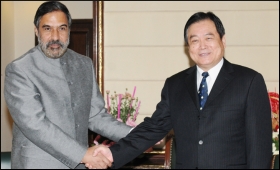
While staying concerned over the huge trade deficit with China, the Union Minister of Commerce and Industry, Anand Sharma expressed optimism that recently unveiled 12th Five Year Plan for 2012-14 of China, with a strong slant for a domestic consumer driven economy will give enormous opportunity for Indian exporters to access China’s huge consumer market in the coming years.

The trade deficit for India for 2010 stood at USD 20.02 billion, more than USD 15.87 billion trade deficit in year 2009 with China, which is an export driven economy.

He met the Jiang Jufeng, Governor of Sichuan Province of China, a province with which India’s trade relations date back to 444 B.C.

During the meeting in New Delhi on Monday, Sharma said, "Sichuan Province of China is very important from Indian point of view and that there is great potential for cooperation between the two regions.  India is an important partner to Sichuan Province, in terms of trade, engineering contracting, and service outsourcing cooperation, as well as an emerging investment destination and source."

Sichuan cuisine is well known in India. By 2010, India has invested in 7 projects in Sichuan, with a contracted foreign investment of USD 10.59 million and actual paid-in foreign capital of USD 6.55 million.

The Province has annual trade of USD 1.2 Billion with USD 1.1 billion in exports to India.

Exported products mainly included electrical and mechanical equipment, audio and video equipment, textiles, metalware and chemicals. Imports from India were USD 98.39 million, including minerals, chemicals and electrical and mechanical products.

In January 2011, total volume of import and export between Sichuan and India soared 41.64% over the previous year, to USD 129 million, including exports of USD 127 million, up 37.2%.

Trade between India and China has witnessed exponential growth in last few years. China has now emerged one of India’s largest trading partners with trade crossing the target of USD 60 billion (total trade USD 61.74 billion) during 2010 and expected to reach USD 100 billion by 2015. 

 
Design by Free WordPress Themes | Bloggerized by Lasantha - Premium Blogger Themes | Grocery Coupons